

It is vital that students learn how their world is a better place because of Christianity's influence.
The controversy over laws in Texas, Louisiana, and Arkansas that require the Ten Commandments to be posted in public school classrooms is often described as a constitutional clash between religion and government. Critics argue that these displays violate the Establishment Clause by encouraging religious belief in public schools.
There is another way to look at the issue. The Ten Commandments played an important role in shaping the American understanding of unalienable rights.
Unalienable Rights from the Commandments
Instead of viewing the Ten Commandments only as religious, they can be taught as a civics lesson that helps explain where America’s idea of freedom came from. The Declaration of Independence states that all people are “endowed by their Creator with certain unalienable rights.” That idea did not appear out of nowhere. Christians during the Reformation, writing two hundred years before America’s founding, believed the Commandments implied basic human rights. Put simply, every “Thou shalt not” also suggested a corresponding “Thou shalt have the freedom to...”.
John Witte, Jr., Professor of Law at Emory University, points out in his essay, "Calvinist Contributions to Freedom in Early Modern Europe," that Reformers saw the Ten Commandments (also referred to as the Decalogue) as more than merely laws about what not to do. The commandments logically assumed certain rights from the Creator. Witte states:
"While the First Table of the Decalogue anchored each person's religious rights...the Second Table anchored each person's natural social rights and correlative duties."
For example, Reformation leaders argued that obeying the first two commandments, “You shall have no other gods before me” and “You shall not make for yourself a graven image,” requires freedom of conscience. If individuals are personally responsible to God for what they believe and how they worship, then the government has no right to force belief or worship. Genuine faith cannot be forced. This reasoning led America’s founders to conclude that even people in religions they believed were wrong must be protected from government pressure, because people are only accountable to God.
From Europe to America
Martin Luther taught that civil authorities go beyond their proper role when they try to control belief. Quoting Jesus’ words in Matthew 10:28 that human power can harm the body but not the soul, Luther argued that using force in matters of faith is both wrong and ineffective. Belief, by its very nature, must be free.
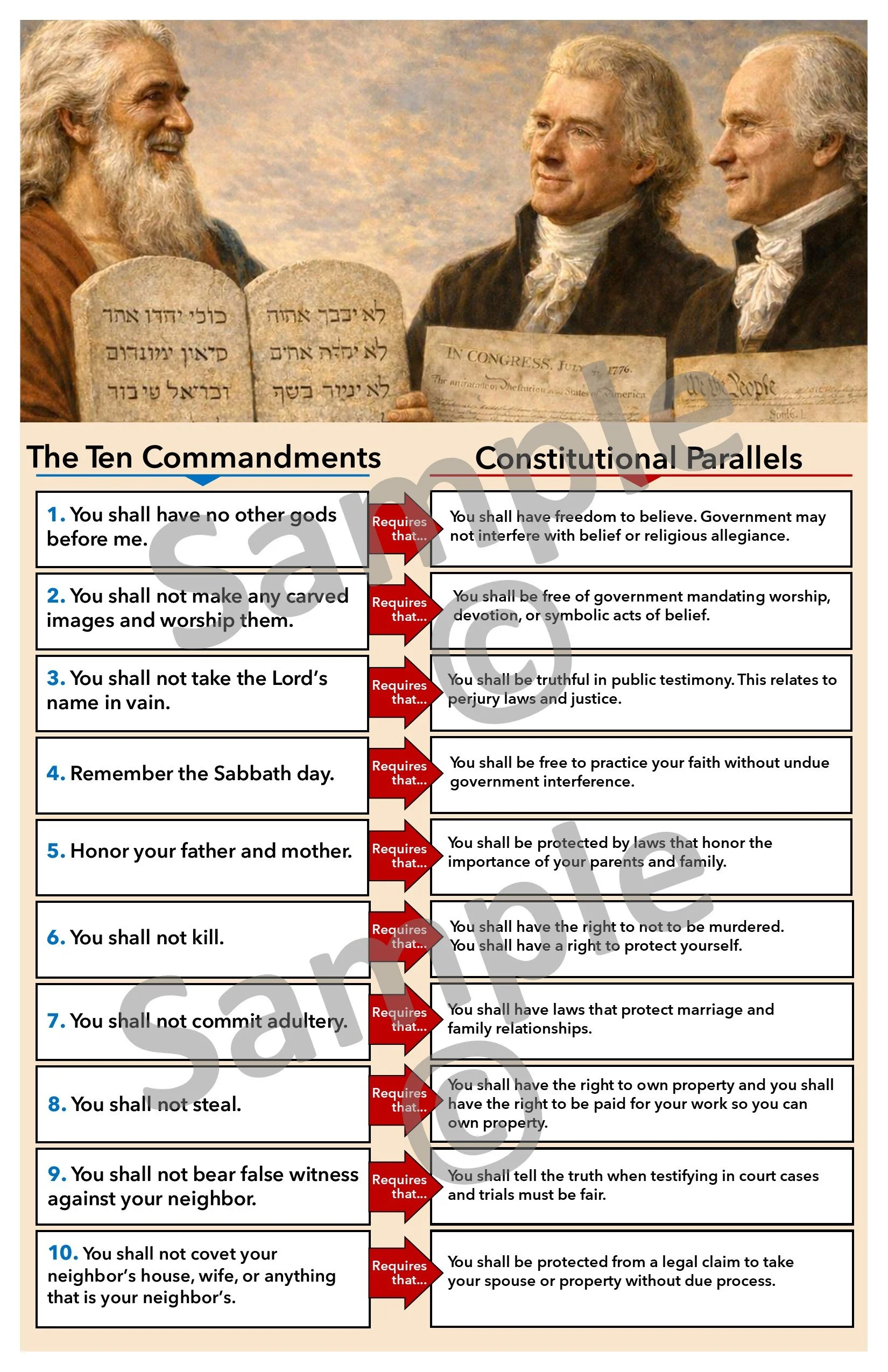
Classroom Poster: We have created an 11x17 Ten Commandments poster that shows the relationship between each commandment and the freedom required for people to live by it.
This idea crossed the Atlantic and strongly influenced America’s founders. Thomas Jefferson reflected this Reformation thinking in the Virginia Statute for Religious Freedom, writing that “Almighty God hath created the mind free” and warning that coercion leads to hypocrisy instead of true belief. Three years later, the ideas behind that statute shaped the First Amendment, which prevents the government from establishing religion or interfering with its free exercise.
Reformers applied the same logic to the rest of the commandments. “You shall not murder” implies a right not to be murdered. In other words, the right to self-defense. “You shall not steal” supports the right to own things. And in order to own things, people have the right to be paid for their work. “You shall not bear false witness” protects reputation and truth-telling, especially in legal settings. The commands against coveting safeguard the family and household, ideas later reflected in the Fourth Amendment’s protection against unreasonable searches and seizures by the government.
Johannes Althusius (pronounced alt-housus) was a lawyer, a Calvinist, and a leader in the new Dutch legal system developed in the late 1560s and 1570s. Witte comments that Althusisus expanded on other Calvinist thinkers' ideas and more fully developed...
"the ideas that the republic is formed by a covenant between the rulers and the people before God; that the foundation of this covenant is the law of God and nature; that the Decalogue is the best expression of this higher law...that violations of these rights and liberties or of the divine and natural laws that inform and empower them, are instances of tyranny that must trigger organized constitutional resistance."
After reviewing many Reformation thinkers who came after theologian John Calvin, Witte wrote that “early modern Calvinism [was] one of the driving engines of Western constitutionalism.”
America’s founders did not try to copy the Ten Commandments directly into the Constitution, but their views on liberty and government were deeply influenced by them. From John Calvin to John Locke, philosophers connected God’s moral law to natural law, and natural law shaped the Declaration of Independence and influenced the structure of the Constitution.
The Ten Commandments can help students understand the reasoning behind America’s freedoms and why limited government is important when our rights come from a higher authority. Regardless of how the courts rule on the legal status of displaying the Ten Commandments, it is important for educators to teach students about their historical significance and connection to the freedoms Americans have today.
Symbolism has its place. But symbolism is only valuable when those who see it understand the substance behind it.
_____________________
"Calvinist Contributions to Freedom in Early Modern Europe," Chapter eight in Christianity and Freedom, Volume 1: Historical Perspectives, Edited by Timothy Samuel Shah and Allen D. Hertzke; Cambridge University Press, 2016, NY, NY
Resources:
Classroom Poster: The Ten Commandments & Constitutional Parallels
Essay: Calvinist Contributions to Freedom in Early Modern Europe, John Witte, Jr.