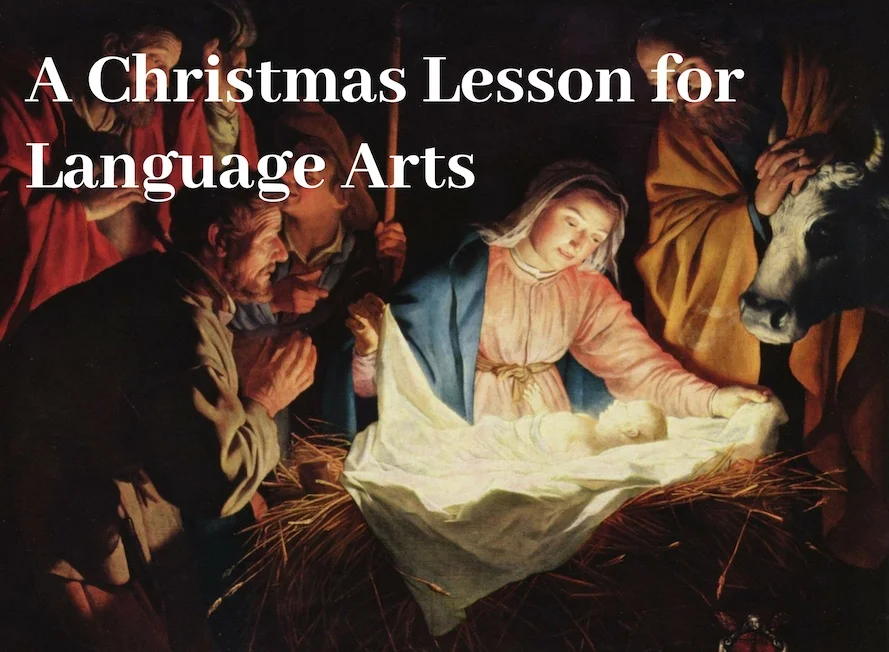
A Christmas Lesson for Language Arts

A+Christmas+Lesson+for+Language+Arts.jpg
Print Friendly and PDF

We recognize birthdays to celebrate the life of a person. On a national level, we celebrate four birthdays of people that have impacted our world: Martin Luther King, Jr. (celebrated as a federal holiday on the third Monday of January), George Washington and Abraham Lincoln (celebrated as a federal holiday on the third Monday of February), and Jesus Christ (celebrated as a federal holiday on December 25).

On their birthdays we don’t make a big deal of baby Martin and George and Abe lying in their cribs in their diapers. Instead, as we should, we acknowledge the impact their lives had, and continue to have, on society.

Christmas, of course, is different because the birth of Jesus was a monumentally different event. No mere human was born. God’s Son became flesh and dwelt among us. The event, and all that surrounded it, is worthy of honor and glory and praise in, and of, itself! For Christians, who make up the majority of Americans, celebrating his birth is a big deal.

teacher+lesson.jpg

I encourage public school teachers to use the run-up to Christmas as an opportunity to not only teach about the biblical account of Jesus’ birth, but also to talk about the impact of his life. Just as teachers use Martin Luther King, Jr. Day and Presidents Day to talk about the impact of these men, teachers should educate students on the impact of Jesus while recognizing his birth.

The history of Western civilization is filled with opportunities to discuss the impact of Jesus on government, culture, and values. Here is an idea involving English/Language Arts that teachers can use to help students appreciate a simple, yet often overlooked, way Jesus influenced our culture.

A Classroom Lesson

Explain that any birthday celebration is a recognition of the life of the person being celebrated. For Christians, the birth of Jesus has important religious significance. However, anyone can appreciate the impact his life had on society. One simple example is found in the common phrases we use.

Introduce students to phrases we use today that had their origin in the words of Jesus. For example, “A house divided against itself…” comes from Matthew 12:25 when Jesus said: “Every kingdom divided against itself is brought to desolation, and every city or house divided against itself will not stand.”

students%2Bstudying.jpg

The phrase means there is no strength in disunity. In his nomination acceptance speech of 1858, Abraham Lincoln famously said “a house divided against itself cannot stand. I believe this government cannot endure, permanently half slave and half free.”

List the phrases (below) on one page. In groups, have students decide what each phrase means and write it next to the phrase.

On another page, give the context of Jesus’ words. Cut and paste the text from an online Bible to provide them with the full context of how Jesus used the phrase. This is not devotional, it’s academic. It is a Language Arts lesson.

If your state has Common Core Language Arts standards, you might even quote the standard at the bottom of the student handout (RL.8.9 “Analyze how a modern work of fiction draws on themes, patterns of events, or character types from myths, traditional stories, or religious works such as the Bible.”)

For California, quote academic standard 6.7.6, “Note the origins of Christianity in the Jewish Messianic prophecies, the life and teachings of Jesus of Nazareth as described in the New Testament…”

For Texas, quote academic standard 113.18(b)(19), “explain the significance of religious holidays and observances such as Christmas…”

If you’d like our research on your state’s academic standards regarding the Bible and Christianity, request it by using gogateways.org/contact.

Here are some examples you could use in your Language Arts lesson:

“Turn the other cheek.” – Matthew 5:39

“Give the shirt off your back.” – Matthew 5:40

“Go the extra mile.” – Matthew 5:41

“A house divided against itself…” – Matthew 12:25

The Good Samaritan – Luke 10:30-37

“Wolf in sheep’s clothing” – Matthew 7:15

“Red sky at night, shepherd’s (or sailor’s) delight.” – Matthew 16:2

“Sign of the times” – Matthew 16:3

“Salt of the earth” – Matthew 5:13

“The spirit is willing, but the flesh is weak.” – Matthew 26:41

Learning about the birth of Jesus is an important cultural lesson for all students. It is also important for them to learn of his teachings that have so impacted the world. Learning about commonly used phrases that originated with Jesus is just a fun and simple way to help students make another connection between the holiday and the culture.

For more resources, visit GoGateways.org/christmas


Eric Buehrer is the president of Gateways to Better Education

"In God We Trust" Promoted in Schools?

Print Friendly and PDF

Six states — Louisiana, Arkansas, Tennessee, Florida, Alabama and Arizona — have recently approved legislation requiring or allowing public schools to display the words “In God We Trust” in prominent locations. South Carolina, North Carolina, Pennsylvania, Oklahoma, and Kentucky may soon pass similar laws.

“In God We Trust” was adopted as the official motto of the United States in 1956. The fourth stanza of “The Star-Spangled Banner,” written during the War of 1812, includes, “And this be our motto: ‘In God is our Trust.’” The motto first appeared on U.S. coins in 1864 and on paper currency in 1957.

TN In God We Trust.png

However, if the phrase is not understood and appreciated, educators, like those at one Tennessee school (see photo), might conform to the letter of the law by simply posting a copy of a dollar bill. Students will never notice it.

Teaching Your Children and Students a Civics Lesson

It is important that educators teach their students the meaning of the motto. From an educational standpoint, every time students see the national motto they should think of its special meaning for the country.

When used as a national motto, the phrase “In God We Trust” is not a personal declaration. Every person in America does not trust in the same God and some do not believe there is a god at all. How can a nation as diverse as ours make such a specific declaration? 

The phrase reflects the civil foundation upon which America was founded in the same way that “one nation under God” does in the Pledge of Allegiance.

The Declaration of Independence states, “We hold these truths to be self-evident that all Men are created equal and endowed by their Creator with certain unalienable rights.”

America is unique in that it sees rights coming from God, not from the government. Instead of the divine right of kings, our Founders asserted the divine rights of the common man. That was truly revolutionary.

Following the lead of the Declaration, nearly every state constitution begins with thankfulness to the “Sovereign Ruler of the Universe” or “Grateful to Almighty God.” When learning civics, students should understand that the laws of their state flowed from the principle that there is a God who gave Mankind certain unalienable rights and that the state legislators were crafting laws to protect (not grant) those rights.

Giving our national motto more visibility is important. However, without parents and educators promoting its importance, schools can conform to the letter of the law and not inspire students about its value for their lives.

Discussion Questions for Students

1. Since all Americans don’t trust in God, why have a national motto stating, “In God We Trust”?

2. What does the preamble to our state’s constitution say about God (click here) and how does that relate to our national motto?

RESOURCE: For lesson plan ideas on a variety of topics, CLICK HERE.


Easter in Public Schools

Easter in Public Schools.png
Print Friendly and PDF

NOTE: Scroll to the bottom for a textbook style lesson about Easter

Education leaders from around the country recognize the importance of students learning about the Bible. For example, a California sixth grade academic standard expects students to learn about "the life and teachings of Jesus of Nazareth as described in the New Testament" (see p. 26; standard 6.7.6)

In Massachusetts,  seventh graders are to "describe the origins of Christianity and its central features: A. monotheism; B. the belief in Jesus as the Messiah and God's son who redeemed humans from sin; C. the concept of salvation; D. belief in the Old and New Testament; E. the lives and teachings of Jesus and Saint Paul." (see p. 47; standard 7.41)

In Florida, sixth-graders are to "identify key figures and the basic beliefs of early Christianity." In Texas, sixth-graders are expected to " explain the significance of religious holidays and observances such as Christmas, Easter…” (scroll to 113.19.B)

eberhard-grossgasteiger-398985.jpg

Objectivity

It is important when teaching students about a religion that you remain objective. The best way to achieve this is by attribution. For example, when introducing a lesson on the Resurrection, explain to students that it is from Luke's account of the life of Jesus. Use phrases such as, "Luke wrote that...," or "The Bible says...".

When referring to beliefs about the story, use phrases such as "Christians believe...," or "Martin Luther King, Jr. believed..." 

Your goal should be to introduce students to the story and help them understand the influence it has had on history, literature, art, and music. The lesson is not designed to prove the story is true, nor question whether the story is accurate.

According to the U.S. Department of Education's guidelines on students' religious liberties, your students have the right to freely express themselves regarding their personal beliefs. However, as moderator of a class discussion on this topic, you should emphasize that every student be respectful regarding their classmates' comments. No student should be made to feel excluded for expressing belief or disbelief in the story.

As a teacher, you can be confident in addressing this topic. This story has had significant influence in world history and should be understood as such. You are not teaching Sunday school; you are teaching a subject that has impacted history, social movements, politics, literature, art, and music.

Resources:

Easter+Lesson+%28page+1%29+reduced+size.jpg

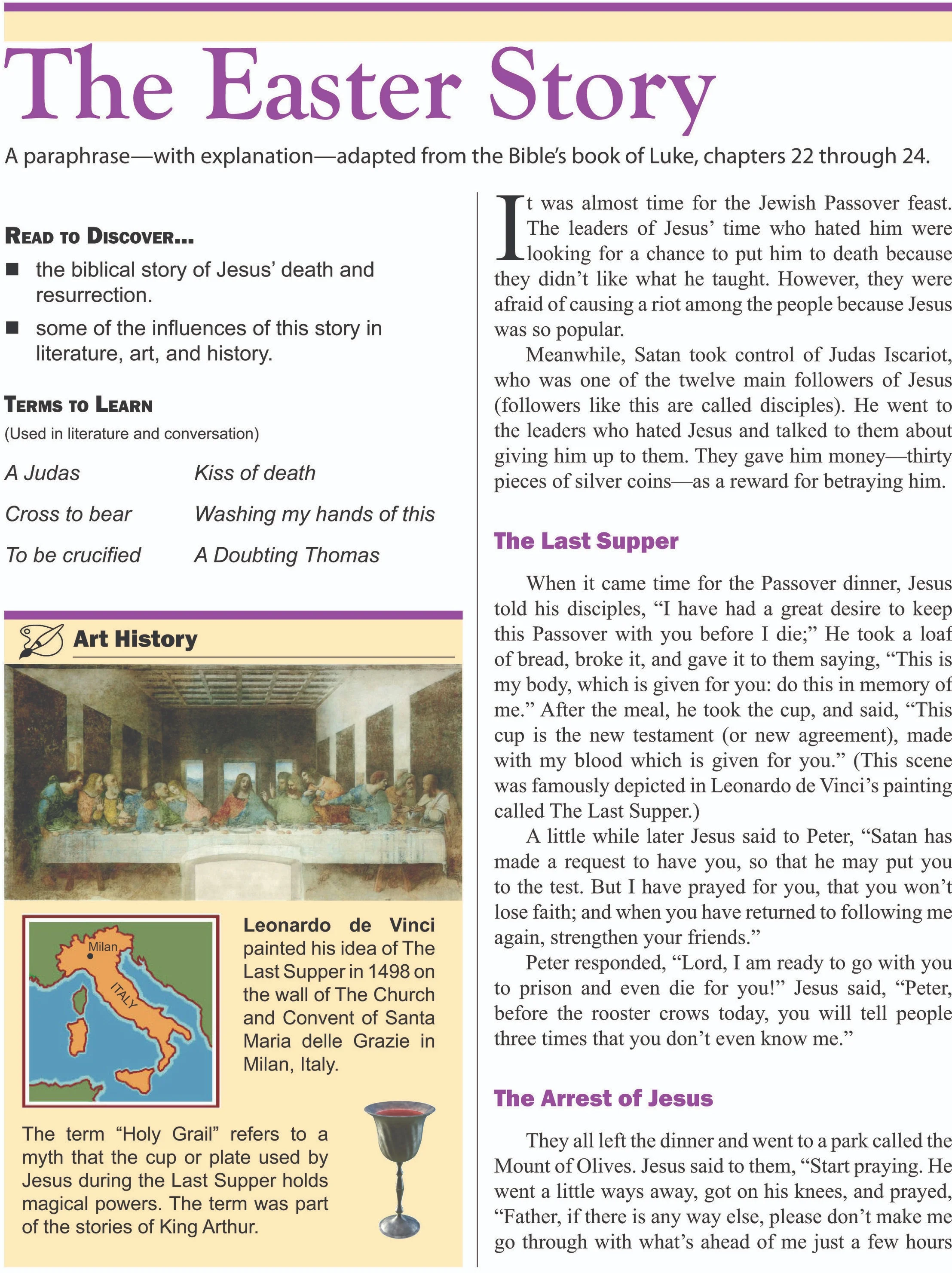
You can download our Easter Lesson Plan for Public Schools by CLICKING HEREIt adapts Luke 22-24 into a textbook-style lesson with pictures, vocabulary, culture facts, and discussion questions.

CLICK HERE to order our EASTER CARD, Bunny Goes to School, for your teacher.

CLICK HERE to share your story about Easter in your public schools.

What is Religious Freedom Day? - Teaching Without Fear, Part 19

Each year since 1993, the President declares January 16th to be “Religious Freedom Day,” and calls upon Americans to “observe this day through appropriate events and activities in homes, schools, and places of worship.” It’s not the day you get to have religious freedom! It’s a day to celebrate the freedom we have year ‘round.

It’s the anniversary of the passage, in 1786, of the Virginia Statute on Religious Freedom. Thomas Jefferson drafted the legislation and considered it one of his greatest achievements. It protected the rights of people to express their religious beliefs without suffering discrimination and it influenced how the First Amendment was written just three years later.

It’s a great opportunity for students to learn a civics lesson about their religious freedom at school. Ask your school to recognize the Day, and have teachers give students a list of their freedoms to express their faith in class.

For more information on Religious Freedom Day and the list of freedoms students have, click on the link below.

Resources:

ReligiousFreedomDay.com