What to look for and how to talk to your child about it
Two prominent views dominate the hotly debated subject of multiculturalism. One rapidly emerging view is that the defining factor for each American is his or her ethnicity. Racial origin becomes paramount in understanding who an individual is and how he or she should live. Schools emphasizing this view highlight and celebrate preservation of past ethnic and cultural distinctions (generally at the expense of teaching students about the wider American culture).
On the other hand, there are those educators who see ethnicity as an enriching ingredient within the uniqueness of American culture, not separate from it. These educators see the American experience as formed by immigrants who cast off significant ties to their old cultures and contribute to the formation of a national identity with a common core of shared ideals. These teachers emphasize commonality of values based on Western civilization, rather than division of values based on cultural ancestry.
What to look for in your student's class that should cause concern:
Watch carefully to see if students are taught what it means to be an American and to appreciate our heritage.
Does the school seem to teach more about Americans' differences than it teaches about their similarities?
Does it seem that the teacher teaches about other countries of the world without teaching about the uniqueness and value of America?
Is Western civilization taught only as exploitative (for example: Columbus plundered and brought disease, Europe colonized Africa and Asia, Spain terrorized South American native cultures, etc.)?
How to talk to your child if you are concerned about multiculturalism at school:
Talk to your student about the beliefs that can bind Americans together. While there are people who put a divisive perspective on everything, it is important that we talk to students about the beliefs that the vast majority of Americans agree help build community. These include such values as our form of government, free enterprise, capitalism, compassion, justice, freedom, opportunity, and personal responsibility. We can disagree on how to best pursue those values, but having common values is necessary for building, rather than fragmenting a nation.
Discuss issues of race and cultural diversity in American culture. During family devotions, incorporate lessons on racial equality and respect. These could include the fact that God shows no partiality (Acts 10:34) and that in His eyes there is neither "Jew nor Greek, slave nor free man, there is neither male nor female" (Gal. 3:28).
© Eric Buehrer
Thinking Biblically in a Public School
“In the information age, plenty of voices are willing to talk with our kids if we aren’t,” write John Stonestreet and Brett Kunkle in their book, A Practical Guide to Culture: Helping the Next Generation Navigate Today’s World. They add that “kids need not only to hear the truth, but they also need to learn what it means to think with truth.”
Thinking with Truth
As Christian parents, we must equip our children to think biblically about what they are learning at school. They must not only learn the content that will get them the right answer for the quiz, but they must also learn to think critically: “How does what I’m learning fit in with what the Bible teaches about God’s world?”
Everyone is influenced by their worldview. There are many good books written about developing a biblical worldview. To simplify it to its basics for Christian students, the question boils down to whether one believes in the God of the Bible or that there is no God – either a biblical worldview or a secular/utilitarian worldview. For many young people who are believers, they could be digesting their academic subjects as if there is no God.
Please help us promote religious freedom in schools.
The overarching themes of a biblical worldview cover four topics in the biblical story: Creation, Fall, Redemption, and Restoration.
As Christian students sit in class or read a textbook, it is helpful for them to ask themselves one question, “How will what I learn today help me think about God?” They should also ask God for insight (see chart below).
Learning is not just about consuming information and getting a good grade. It is also about developing ourselves to love God, love others, and contribute to our world. Thinking biblically in every classroom and with each assignment helps us become the people God wants us to be.
Help Your Child
To help your children think biblically about what they learn at school have them ask themselves one question: How will what I learn today help me think about God? Then, before class starts or before doing homework, they can do two simple things: Think and Pray. For example, when it comes to science, your children can think this thought: God created the world with order. As I learn about science, I can think about how awesome God’s design is revealed. Then, they can pray this short prayer: “Lord, help me marvel at how You have designed things as I learn about science.”
We’ve created a simple guide they can use, and you can download. This one-page guide will help shape a biblical worldview regarding nine topics: science, math, history, government & civics, literature, spelling & grammar, art & music, foreign language, and health. It gives them something to think about and a short prayer before class or before doing their homework.
Addressing the Spiritual Hole in Whole Child Education
Eleven Religious Liberties
Here are eleven freedoms outlined in 2023 by the U.S. Department of Education. There are eight for students and three for educators.
Students
You can pray, read your Bible or other religious material, and talk about your faith at school.
You can organize prayer groups and religious clubs, and you can announce your meetings.
You can express your faith in your class work and homework.
You can wear clothing with religious messages.
You may be able to go off campus to have religious studies during school hours.
You can express your faith at a school event.
You can express your faith at your graduation ceremony.
You can pass out religious literature at school.
Educators
Educators and school employees can pray at school.
Educators can teach about religion in class.
Schools can accommodate religious instruction and prayer during school.
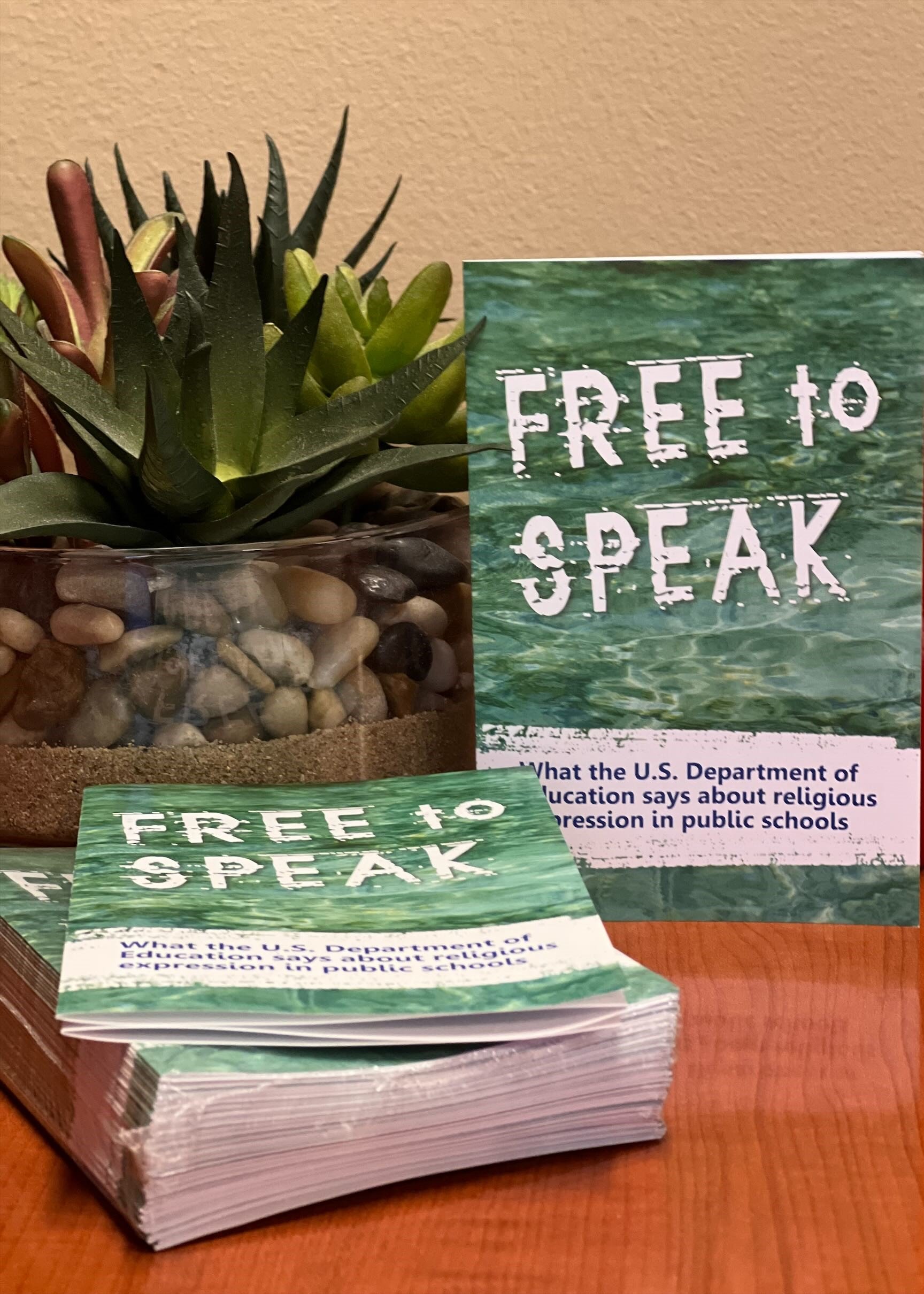
We have Free to Speak pamphlets using quotes directly from the U.S. Department of Education. The pamphlet clarifies for parents, students, and educators the freedoms of religious expression on a public school campus. They are designed to fit in your wallet or backpack. For more information on ordering go to our STORE.
To read what you can do to promote greater religious freedom at your schools, click here.
Every January 16th is Religious Freedom Day - Visit our Religious Freedom Day website for ways to commemorate this special day.
Click HERE for the U.S. Department of Education’s Guidance on Constitutionally Protected Prayer and Religious Expression in Public Elementary and Secondary Schools.
Sign up for our E-newsletter HERE
What's New about the New Guidance on Religious Freedom
A closer look at the Department of Education’s new Guidance on Constitutionally Protected Prayer and Religious Expression in Public Elementary and Secondary Schools
By Eric Buehrer
President Trump and Eric Buehrer during the Oval Office announcement
On January 16, 2020, President Trump announced the release of the Guidance on Constitutionally Protected Prayer and Religious Expression in Public Elementary and Secondary Schools. I had the privilege of joining the President, Secretary Betsy DeVos, Deputy Attorney General Jeffrey Rosen, along with a few students, parents, and teachers for the press event in the Oval Office.
Accountability
In 2002, Congress amended the Elementary and Secondary Education Act to require that public schools certify they have no policy against students praying at school. That was a rather low bar. A school might not have had an official policy against prayer, but in practice they might have repressed it.
The new Guidance (Section 8524(b) adds accountability where SEA’s (State Education Agencies) must send to the Secretary (by November 1st) a list of LEAs (Local Education Agencies) that have not filed the required certification or that have been the subject of a complaint to the SEA alleging that the LEA has a policy that prevents, or otherwise denies participation in, constitutionally protected prayer in public elementary and secondary schools. This includes complaints that the SEA may deem meritless.
Our Recommendations
Eric Buehrer with Secretary Betsy DeVos in the White House
In the spring of 2017, our team at Gateways to Better Education, including Dr. William Jeynes, professor of education at Cal State University, Long Beach, first wrote to Secretary DeVos informing her of the previous administration’s neglect in reissuing the guidelines. They had not been updated since 2003. We also made specific recommendations to improve them.
We suggested they return portions of the 1995 guidance that had been removed in 2003. This dealt with student expression beyond merely prayer. The department acted on our advice and included the following:
“Students may also speak to, and attempt to persuade, their peers about religious topics just as they do with regard to political topics.”
“Religious Literature – Students have a right to distribute religious literature to their schoolmates on the same terms as they are permitted to distribute other literature that is unrelated to school curriculum or activities. Schools may impose the same reasonable time, place, and manner or other constitutional restrictions on distribution of religious literature as they do on non-school literature generally, but they may not single out religious literature for special regulation.”
“Teaching about Religion – Public schools may not provide religious instruction, but they may teach about religion. For example, philosophical questions concerning religion, the history of religion, comparative religion, the Bible (or other religious teachings) as literature, and the role of religion in the history of the United States and other countries all are permissible public school subjects. Similarly, it is permissible to consider religious influences on philosophy, art, music, literature, and social studies. Although public schools may teach about religious holidays, including their religious aspects, and may celebrate the secular aspects of holidays, schools may not observe holidays as religious events or promote such observance by students.”
The department also included our recommendation for guidance on student dress codes:
“Student Dress Codes and Policies – Schools enjoy substantial discretion in adopting policies relating to student dress and school uniforms. Schools, however, may not single out religious attire in general, or attire of a particular religion, for prohibition or regulation. If a school makes exceptions to the dress code for nonreligious reasons, it must also make exceptions for religious reasons, absent a compelling interest. Students may display religious messages on items of clothing to the same extent that they are permitted to display other comparable messages. Religious messages may not be singled out for suppression, but rather are subject to the same rules as generally apply to comparable messages.”
In addition to these improvements, the department added a brief section with guidance on the Equal Access Act based on recent court rulings and interpretations from the Justice Department. The Equal Access Act allows for religious student clubs to be formed on campus. It added an important statement on the right for student clubs to require its leadership to hold the club’s religious beliefs. While this may seem obvious, there are some activists who are pushing to require clubs to not “discriminate” against people who want to lead the club but not believe in the clubs religious doctrines.
Several times in the new guidelines, the words “religious content” were replaced with “religious perspective.” This subtle change will help as the pressure grows on educators to suppress the religious viewpoints of students on controversial cultural topics such as abortion, same-sex marriage, and gender identity. The new guidance makes clear, these students’ religious perspectives are not to be silenced.
We are grateful to Secretary DeVos and the USDOE for highlighting the rights of students and teachers to live out their faith at school.
Now the work must begin to spread the word to every school, every student, every teacher, and every parent. - Eric Buehrer, President, Gateways to Better Education
To help spread the word, visit the National Free to Speak Campaign.
USDOE Guidance, May 15, 2023
Donate to help spread the word.