National Free to Speak Campaign

j0439453.jpg
Print Friendly and PDF

Overview

Gateways to Better Education and the Alliance Defending Freedom (ADF) have teamed up to help churches equip families with information on students' and teachers' freedom of religious expression in their public schools.

Two important things will happen because of your church's involvement. YOU WILL:

Equip your students and congregation. Gateways has created a pocket-sized pamphlet entitled Free to Speak. It quotes the U.S. Department of Education statements clarifying seven important religious freedoms on public school campuses. There are 50 pamphlets in a set.
Bring clarity on the issue for local school officials. The Alliance Defending Freedom (ADF) has created a detailed letter and stands ready to send it to school officials you designate. They have donated their time to the campaign by offering to send this letter to one school official for every set of pamphlets you order for your church, Sunday school, Youth group, or campus Bible club. You will be able to designate the schools as part of your ordering process. (Your name will not be mentioned in the letter.)

GET STARTED NOW 

Here's a simple way to equip your congregation, and impact your local schools with just a two-minute pulpit announcement:
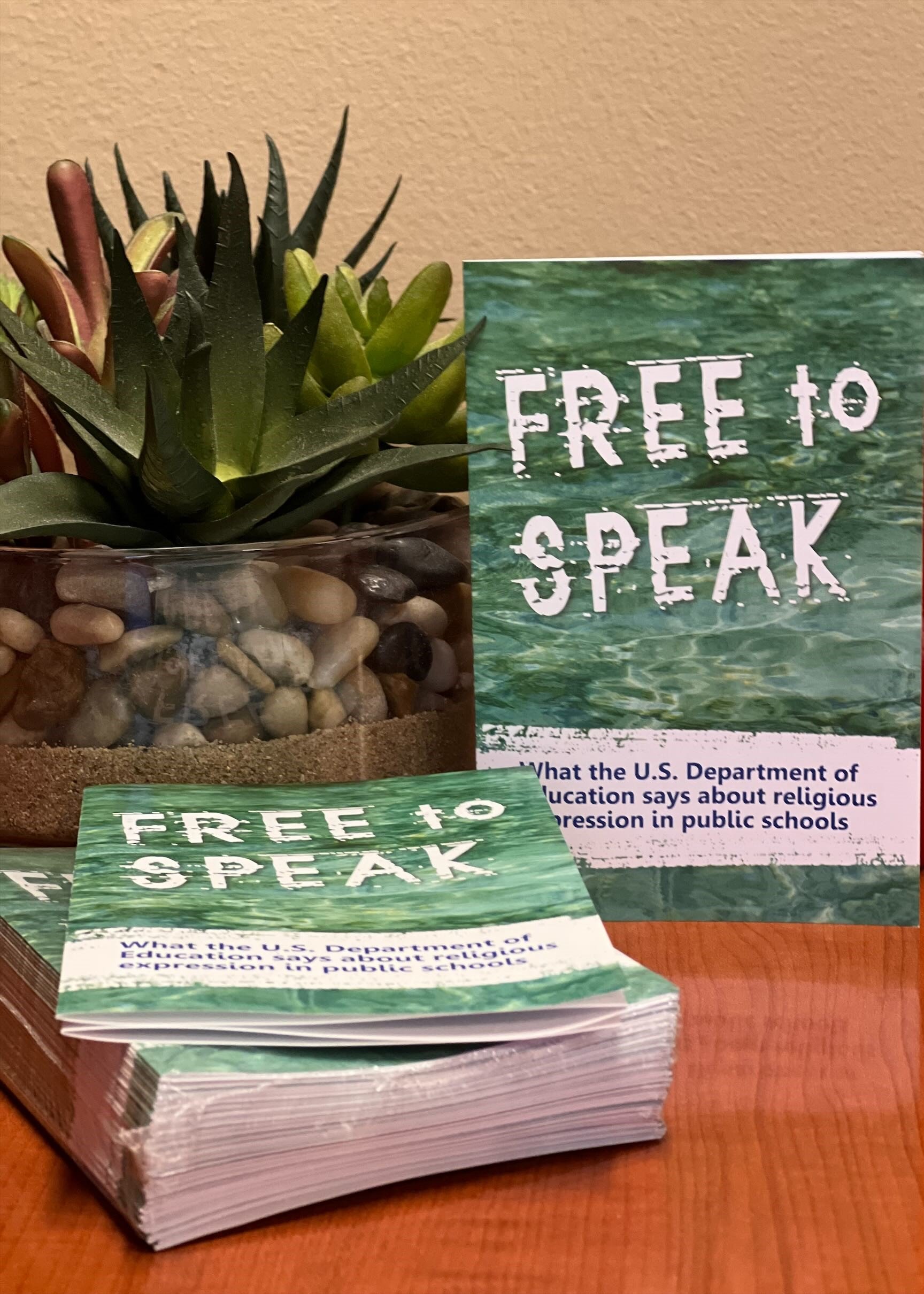
  1. Put a Free to Speak pamphlet in each church bulletin.

  2. Honor and pray for the educators in your congregation.

  3. Have stacks of the Free to Speak pamphlet in your church foyer for people to give to students, teachers, and friends during the week.

  4. Let them know that because of your church's participation, school principals in your local schools will be receiving a six-page letter from ADF clarifying students' and teachers' freedom of religious expression.

For example, if your church has 200 people in its worship service and 30 students in its children's and youth programs, we recommend you order one for each bulletin (200), 100 extra to place in the church foyer, and 10 for each student to give away at school (300), for a total order of 600 pamphlets (12 packets of 50 pamphlets. You can, then, designate twelve school officials to receive the special letter from an ADF attorney. (Note: if another church in your community designates the same school official that you select, we will have ADF send the letter to a nearby school official who has not yet been selected. This will avoid duplication and expand the impact of the campaign.)

Here's what you do next to promote greater religious liberty in the schools in your community!

Order Your Free to Speak pamphlets now and designate which school officials you want to receive the letter from the Alliance Defending Freedom.

Download an easy-to-follow manual for promoting religious freedom in your church and community. CLICK HERE.

Give to help the campaign reach more schools. If you don't want to order pamphlets yourself, donate to the National Free to Speak Campaign and we will send pamphlets directly to teachers for you. Working with a national teachers' prayer group, we have identified 80,000 Christian public school teachers. For every donation of $30, we can donate 50 pamphlets and send the ADF letter giving more detail about religious freedom in public schools directly to a teachers' on-campus prayer group. 

older kids on steps.png

What Others Are Doing

An attorney from Arlington, Texas, (with 63,000 students in the local schools) wrote:

“My church placed Free to Speak in each church bulletin. I then led the congregation in prayer and was in the church foyer after the service to answer questions from students and their parents.” 

A school board member from Florida promoted Free to Speak to her pastor who, in turn, “ordered the pamphlets and asked everyone even remotely involved in the public schools to take a handful!”

“(In our church) we recognized our educators, both active and retired. We then had a retired educator speak about the changes he had experienced in the school system concerning our religious rights. He then prayed especially for our educators. We handed out the Free to Speak pamphlets after the service to everyone as they were leaving, making sure the teachers received extra copies to hand out at school.

FAQs

1. The Free to Speak pamphlet focuses mainly on students. What about teachers’ freedom of expression?

Of the seven points quoted in the pamphlet, one addresses teachers’ freedom to meet with colleagues for prayer and religious discussions during their free time (such as lunch). As part of the campaign, the letter written by the Alliance Defense Fund (and sent to the school officials you choose) answers six questions commonly asked about teachers’ rights.

2. Can I get a copy of the letter the Alliance Defending Freedom (ADF) sends to school officials?

You can designate yourself as one of the people to receive the letter when you order your Free to Speak pamphlets.  

3. Where can I find the names and addresses of school officials in my community?

Most schools and school districts have web sites with the information.

4. How should I distribute the pamphlets?

Churches, civic groups, social clubs, and youth organizations are natural places to distribute the pamphlets. If you distribute them through your church you can place one in each bulletin and have extras in the foyer. We recommend that you get ten copies to each student (elementary and secondary) in your church. Encourage them to keep one and give nine to classmates and teachers.  

5. Do I need permission to distribute the pamphlets at school?

Students can give the pamphlets to people at school just as they would in any other personal communication. However, mass distribution (for instance, in the hallways) may be subject to school policies regarding distribution of any flyers on campus.

6. Is the National Free to Speak Campaign an attempt to proselytize in public schools?

The Free to Speak pamphlet focuses on the protection of privately initiated religious expression and activities from government interference and discrimination. The pamphlet contains no religious message. To order pamphlets, click here.
Eleven Religious Liberties

U.S. Department of Education Guidance (January 2020)

Religious Freedom Sunday

k-155-chim-09021-id-20116-jpeg.jpg
Print Friendly and PDF

To increase national awareness for the President’s annual proclamation of Religious Freedom Day (January 16), Gateways and the Alliance Defense Fund are promoting Religious Freedom Sunday—celebrated each year the Sunday before Religious Freedom Day. 

Religious Freedom Sunday is a national event in which churches honor the educators within their congregations and inform their congregations about the freedom of religious expression students from kindergarten through twelfth grade have at school. 

The theme for Religious Freedom Sunday comes from the Bible verse quoted on the Liberty Bell—‘proclaim liberty throughout the land’ (Leviticus 25:10).

Drawing Attention to Religious Freedom Day

RFD+logo+2018.png

Each year, the President declares January 16th to be Religious Freedom Day, and calls upon Americans to “observe this day through appropriate events and activities in homes, schools, and places of worship.” 

The day is the anniversary of the passage, in 1786, of the Virginia Statute on Religious Freedom. Thomas Jefferson drafted the legislation and considered it one of his greatest achievements. It stopped the practice of taxing people to pay for the support of the local clergy, and it protected the civil rights of people to express their religious beliefs without suffering discrimination. For a free, downloadable booklet explaining more about Jefferson’s legislation, visit www.ReligiousFreedomDay.com

Today, that protection is as important as ever. In too many instances, public school teachers tell Christian students they cannot include their faith in their homework assignments or classroom discussions. However, the U.S. Department of Education has issued guidance explaining students’ religious liberties. (In 2020, the guidance were updated and Gateways was invited to the White House for the release.) Students can pray, read their Bibles, and talk about their faith at school during school hours. They can organize prayer groups and Bible studies and announce their meetings. They can express their faith in their art, class work and homework. And more!

Promoting Students' Freedom of Religious Expression

Sunday isn't the only day to inform students, teachers, and parents about religious liberties at school. The week leading up to, or following, Religious Freedom Day is a great time for students in campus Bible clubs to distribute information to classmates and educators.

Free to Speak is a pocket-sized pamphlet designed for students. If each student in a campus Bible club or church youth group receives ten pamphlets they can keep one and give nine to their friends and teachers during the week leading up to Religious Freedom Day.

REACH YOUR LOCAL SCHOOLS: For every package of 50 pamphlets you or your church orders, the Alliance Defending Freedom has donated its time to send a six-page letter to the school official of your choice. The letter cites Supreme Court cases clarifying students' and teachers' religious liberties. 

A Two-Minute Pulpit Announcement

Here is an easy idea your church can incorporate in your services:

1. Put a Free to Speak student pamphlet in each church bulletin. Order enough pamphlets to hand out in Sunday school classrooms and youth meetings.

To order Free to Speak pamphlets visit our secure online store. Be sure to order enough for to have extras in your church foyer or information center.

2. Show our 60-second video announcement (see www.ReligiousFreedomSunday.com)

3. Honor and pray for the educators in your congregation. Offer a prayer of thanks and blessing for them.

5.  Print our Religious Freedom Day Guidebook and give to school leaders or educators in your congregation.

TO ORDER Free to Speak pamphlets, CLICK HERE.

Be sure to email Gateways your story regarding how you celebrated Religious Freedom Sunday and/or how you distributed Free to Speak in your local schools. To write us, CLICK HERE. 

Sample School Board Resolution for Religious Freedom Day

k-138-rung-3553-id-18500-jpeg.jpg
Print Friendly and PDF

Resolution for Religious Freedom Day

Whereas, the right to religious freedom is a pillar of American society, and

Whereas, our Founding Fathers knew the importance of freedom of religion for a stable democracy, and our Constitution protects the free exercise of religion, and

Whereas, January 16th celebrates the anniversary of the 1786 Virginia Statute on Religious Freedom that restrained the practice of taxing people to pay for the support of the local clergy, and protected the civil rights of people to express their religious beliefs without suffering discrimination. This statue serves as the model for protecting religious freedom as evidence in the First Amendment to the United States Constitution, and

Whereas, each year the President of the United States declares January 16th to be “Religious Freedom Day,” and calls upon Americans to “observe this day through appropriate events and activities in homes, schools, and places of worship,” and

Whereas, Section 9524 of the Elementary and Secondary Education Act ("ESEA") of 1965, as amended by the No Child Left Behind Act of 2001, requires as a condition of receiving ESEA funds, that a local educational agency ("LEA") must certify in writing to its State educational agency ("SEA") that it has no policy that prevents, or otherwise denies participation in, constitutionally protected prayer in public schools, and

Whereas, the [--- school district name --- ] declares that it does not find or promote   policies that prevents, or otherwise denies participation in, constitutionally protected prayer in public schools as set forth in ESEA, Section 9524 guidance, and

Whereas, the U.S. Department of Education has developed guidelines clarifying the freedom of religious expression in public schools and requested that schools inform educators, students, and parents of these liberties,

Therefore, be it resolved that, the [--- school district name --- ] acknowledges January 16, [year], as Religious Freedom Day in the United States of America, and

Further, the [--- school district name --- ] encourages all Americans to reflect on the great blessing of religious liberty; preserve this freedom for future generations; and commemorate this day with appropriate events and activities in their schools, places of worship, neighborhoods, and homes.

Further, the board of education calls on the schools of [--- school district name --- ] to commemorate this day and promote clarity and respect by providing its staff and students with information on freedom of religious expression in our schools.

http://www.ed.gov/policy/gen/guid/religionandschools/prayer_guidance.html

Commemorating Religious Freedom Day

RFD logo with website 2018.png
Print Friendly and PDF

Religious Freedom Day

Each year, the President declares January 16th to be “Religious Freedom Day,” and calls upon Americans to “observe this day through appropriate events and activities in homes, schools, and places of worship.” It is the anniversary of the passage, in 1786, of the Virginia Statute Virginia Statute on Religious Freedom. Thomas Jefferson drafted the legislation and considered it one of his greatest achievements. It stopped the practice of taxing people to pay for the support of the local clergy, and it protected the civil rights of people to express their religious beliefs without suffering discrimination. (Download our free Religious Freedom Day Guide.)

The men who drafted the U.S. Constitution leaned heavily on Jefferson’s statute in establishing the First Amendment’s guarantee of religious freedom.

Today, that protection is as important as ever. In too many instances, public school teachers tell students they cannot include their faith in their homework assignments or classroom discussions.

The U.S. Department of Education has issued guidelines explaining students’ religious liberties. Talking about religious liberties (especially explaining students' liberties to parents) will make an administrator’s job easier because it will clarify that schools need not be “religion free zones.” It is often the case that parents who complain to school officials about what they think are violations of the separation of church and state do not understand the appropriate and lawful place religious expression can have at school. 

The Message of Religious Freedom Day 

The main message students need to hear is that they shouldn't feel like they have to be “undercover” about their religion – that somehow, they have to keep quiet about their family's beliefs. School officials might be hesitant to acknowledge Religious Freedom Day thinking they will need to have a school assembly giving a platform to various religious speakers. This is not necessary. Religious Freedom Day is an opportunity for a civics lesson regarding Americans’ freedom to express and live out their faith.

Commemoration Ideas 

In commemorating the day, a school could have an assembly or could ask teachers to recognize it in their classrooms. Either way, here are some ideas for acknowledging Religious Freedom Day at your school: 

1. Read the Presidential Proclamation. You will find this at www.whitehouse.gov. At the White House Web site, enter a search for “Religious Freedom Day.” If this year’s proclamation is not posted in time for you to use it in class, consider using previous year’s proclamations. For links to previous proclamations go to www.ReligiousFreedomDay.com.

2. Have students write a paper on “What religious freedom means to me.”

3. Distribute to students copies of the U.S. Department of Education’s guidelines on students’ religious liberties. If you did nothing else to commemorate Religious Freedom Day, this alone would do more to promote real freedom at your school. You could also write a letter to parents and staple it to the guidelines. The letter can introduce Religious Freedom Day and convey, “Our school is a safe place for your child to express your family’s religious faith.” (Visit www.ReligiousFreedomDay.com for more information.)

4. Talk about countries where freedom of religion is not allowed. For research on this, visit http://www.uscirf.gov/

5. Distribute and discuss the Virginia Statute on Religious Freedom drafted by Thomas Jefferson. (January 16 is the anniversary of the passage of this statute). For a copy of the statute, and an easier-to-read paraphrase of this document, visit www.ReligiousFreedomDay.com

Religious Liberties 

Freedom of speech can take different forms. It includes what you say to other people as well as your freedom to speak to God in prayer; it includes what you write in school assignments or what you create in an art class; it includes the words you give to a friend either by speaking or in writing. The information below comes from the U.S. Department of Education’s document Guidance on Constitutionally Protected Prayer and Religious Expression in Public Elementary and Secondary Schools (Jan 2020)

Here is a summary of the U.S. Department of Education’s guidance:

Students

  1. You can pray, read your Bible or other religious material, and talk about your faith at school.

  2. You can organize prayer groups and religious clubs, and you can announce your meetings.

  3. You can express your faith in your class work and homework.

  4. You can wear clothing with religious messages.

  5. You may be able to go off campus to have religious studies during school hours.

  6. You can express your faith at a school event.

  7. You can express your faith at your graduation ceremony.

  8. You can pass out religious literature at school.

Educators

  1. Educators and school employees can pray at school.

  2. Educators can teach about religion in class.

  3. Schools can accommodate religious instruction and prayer during school.

Accountability

In 2002, Congress amended the Elementary and Secondary Education Act to require that public schools certify they have no policy against students praying at school. That is a rather low bar. A school might not have an official policy against prayer, but in practice they might repress it.

As of January 2020, schools must report any complaints against them. Under DeVos’ leadership, the Department of Education has made clear that states must have a process for students, parents and teachers to report violations of their right to participate in protected religious expression. It requires each state to notify the Department of any complaint against schools alleging violations even if the state deems them to be without merit.

Related Links

ReligiousFreedomDay.com

Religious Freedom Day Guidebook

The National Free to Speak Campaign

Free to Speak pamphlets

Presidential Proclamations (ReligiousFreedomDay.com - scroll down on main page)


Teacher Blessed by Gateways Seminar

285-jir-6082-nam-eye-id-392551-jpeg.jpg
I've never been more confident in how and what I teach. I have a Bible on my desk, in my classroom library, and freely speak of the reason we broke away from England; that Christianity was brought with those who broke away from England. I tackle the "other" side of evolution and answer students' questions when they see me reading my Bible during Silent Reading time. 

My students know the meaning of the American flag, what our flag stands for and why it is important. 

The workshop was an amazing release of anxiety and apprhension. I'm ready to defend my rights as teacher whenever someone wants to challenge me. I'd love to take your class again. What an inspiration. I've told my Christian teacher friends, my pastor, and our church members about the wonderful things you are doing. I even loaned my class materials and workbook to a group of teachers from another district. The message is getting out there. 

Thank you for all you do, 
Janice
Learn More