
Teaching and Promoting Tolerance

Print Friendly and PDF

Article Updated 02/19/2025

The Need for a Clear and Practical Definition

In recent years, schools have given an increasing amount of attention to issues surrounding diversity and tolerance. Character education courses, multicultural material, and even health curricula weave the theme of tolerance through their lessons.

Incidents such as the Charlottesville white nationalist rally or the South Carolina church shooting by white supremacist Dylann Roof shock us into the reality that hate-motivated crime is still alive in America.

While some people use these tragedies to create the appearance of a crisis largely for political reasons, it must be pointed out that incidents of hate crimes are relatively rare. For example, the FBI shows that there were 11,862 hate crimes in 2023. However, in 2023, there were an estimated 1.22 million aggravated assaults 11, 862 is only 0.97% of all 1.22 million aggravated assaults. (Of course, the rarity of the occurrences is little consolation to the victims.)

Clearly, we are not a nation of bigots and haters, though the spotlight put on certain incidents might make it appear that way. The need for tolerance is not because of an epidemic of hate crimes, but because of the much more mundane and daily social interactions that require treating each other with respect and dignity. It is in these interactions where educators deal with intolerance most frequently: hallway insults, angry outbursts, and smug dismissals of others' viewpoints during class discussions.

Not only do educators deal with these types of social interactions among students, they, too, are tested in their tolerance for student clothing, hair styles, body piercing, attitudes, morals, and behaviors.

Defining Tolerance

When some use the word tolerance, they mean the first definition you find in the dictionary: recognition of and respect for the opinions, practices, or behavior of others. However, it is important to understand that respect here means, not veneration, but the avoidance of interference. Without this clarification, the definition of tolerance comes to be viewed as a gushing acceptance of just about everything someone says or does. Some even go so far as to define tolerance as the embracing and celebration of the opinions, practices, or behaviors of others.

Many educators and parents, however, cringe at the moral relativism of this approach. Yet, they feel boxed in by the current talk of tolerance. If they oppose it, they run the risk of being accused of advocating bigotry, intolerance, and even hate. This is because those promoting the most open-ended view of tolerance have staked out the playing field by defining the terminology. Pressure then gets placed on colleagues and students to adopt this view of tolerance. To resist is to appear intolerant.

Tolerance Requires Virtue

Tolerance, in and of itself, is not a virtue. If a student tolerates drinking and driving, his tolerance is not virtuous. Tolerance is neutral. Tolerance derives its value from what it is the student tolerates, and the manner in which the student expresses his tolerance and intolerance. This involves character.

When a student uses a racial slur, his problem is not a lack of tolerance, but a lack of kindness and a problem with pride (the root of belief in racial superiority). When a student makes fun of a classmate's point of view during a class discussion, his problem isn't a lack of tolerance, but a lack of courtesy. When one student spits on another student because he thinks his schoolmate is gay, tolerance isn't the issue so much as is self-control.

Proper tolerance is the outgrowth of moral character qualities such as kindness, patience, courtesy, humility, love, self-control, and courage. Even intolerance should be expressed through these qualities.

Students need to be taught that tolerance arises from character. If they don't understand this, they will think they are being tolerant when they are actually only expressing indifference ("whatever"), or apathy ("who cares?"), or even recklessness ("why not?"). Improperly taught, "tolerance education" can lead to disarming students of their proper convictions.

Tolerance Requires Standards

The view that tolerance means, "accepting everyone's ideas and behaviors" is impractical in the real world. It sounds nice in classroom discussions and school board declarations, but it won't work in the hallways. You will find a more practical definition of tolerance in the dictionary's second definition of the term: the allowable variation from a standard. For instance, an engineer might ask about the tolerance of a metal beam in a building during an earthquake. How far should it bend before serious structural damage is done?

This is the definition by which we most commonly live. We establish a standard of what we think is best (even if somewhat vague). We then establish an allowable variation from that standard (often more vague). Then we judge the ideas and actions of others based on what we've established. This is as it should be. To do otherwise is to invite social and moral anarchy. The problem for many people isn't intolerance; it is in not clearly defining their standards.

Even so, we establish standards in hundreds, even thousands, of categories. For example, the First Amendment states that Americans have the right to peacefully assemble and petition their government. In other words, to protest something. Offensive words may be said and even annoying actions may take place. Though offensive to some, these actions are still legally tolerable. What is illegal (intolerable) is when actions become violent and the property of others is stolen or damaged.

Within the school setting, this definition of tolerance is applied in many places: dress codes (pants are allowed, but not hot pants), hallway conduct (conversation between boys and girls is allowed, but not sexual harassment), and classroom participation (students may not have to participate in discussions, but they can't fall asleep).

This practical definition is valuable for classroom instruction because it honors students' moral frameworks developed by their religious education and families. Rather than teach them that tolerance is best demonstrated by an absence of judgment, it teaches that tolerance requires making judgments: first, establishing a standard, and second, establishing the limits of the allowable variation.

If students aren't taught to clearly establish their standards and allowable variations, they will struggle with what to tolerate. In frustration, they may simply jump to the sophomoric view that they should just accept everything. This doesn't require hard thinking and yet has the appearance of taking the moral high ground.

Some may raise the concern that making judgments will only add to someone's existing prejudices. There are two reasons why this doesn't have to be. First, as we have seen, the reality is that this is the way tolerance really works, so the best course of action is to help students think deeply about their standards. Secondly, no matter what their standards are, they should act virtuously toward anyone who varies from those standards.

Ironically, educators can create more "tolerant" school climates by focusing not on tolerance, but on character.

Click here for a practical student handout that explains a better definition of tolerance.

© Gateways To Better Education

Challenging a Book in Your School

redd-angelo-12845-unsplash.jpg
Print Friendly and PDF

There are many educators who believe that when parents question something being taught in the classroom, it's meddling. When parents ask to have something removed...it's censorship! But, is it? To hear certain groups tell it, you'd conclude that Hitler is alive and well and lurking in the wings of Hooterville High School. 

Definitions

The word "censorship" as it applies, or is misapplied, to school issues seems hard to define. The dictionary defines a censor as, "one authorized to examine material, as literature or plays, and remove or suppress anything considered objectionable." If that definition were applied to a school district, every school board member, administrator, and educator would be a censor. They are all authorized to examine material and suppress (by not choosing) all kinds of books and programs to which students could be exposed. 

Even the pros struggle with applying censorship to classroom situations. Edward B. Jenkinson who served as the chairman of the National Council of Teachers of English's Committee Against Censorship takes a stab at clarifying the issue for us in his book Censors In The Classroom: The Mind Benders. He not only falls short in his attempt, he admits defeat in the introduction of the book: 

"I, too, am a censor. I do not permit my daughter to watch certain television shows because they are filled with crime and violence. I do not want her to read certain literary works because I believe that she is not yet ready for them. As a parent, I feel that I have a moral obligation to be concerned about what my child sees and reads." (p.xvi) 

Recognizing that his book would be pretty short if he left it at that, Mr. Jenkinson goes on: 

"On the other hand, I know I do not have the right to impose my standards on the other children in her class or in the nation. I must live with the constant uncertainty that by denying her the right to read or see anything, I may be seriously limiting her education. I do not know exactly what is best for my child — I can only try to provide what I think is right. But the public censor apparently knows what is best for all children." 

Now, I'm not picking on Mr. Jenkinson, but after all, he did write the book. The whole problem of censorship in the classroom is a clash between private and public censorship. 

When Mr. Jenkinson sends his daughter to the public school, he must decide whether or not his "moral obligation" extends into the classroom. If it is truly an obligation, he must inject himself into that classroom. Otherwise he, or any other parent, must alter his sense of moral obligation by stating, "I feel that I have a moral obligation to be concerned about what my child sees and reads...except in school; then, anything is acceptable." Not much of an obligation, is it? 

The question of "moral obligation" also goes on in the mind of the teacher. She is the "imposer" of values ranging from conduct, hygiene, speech, academics, and, yes, what is valuable for children to read. And, yet, she is only one person, just like a parent. When a parent questions the validity of a book in school, we call it a censorship challenge. But when the teacher does it, we call it part of the job. Maybe censorship is part of the job! 

So, What is Censorship? 

Reason causes me to conclude that to be an educator is to be a censor. The word "censor" has become a bad word. It is used today to emotionalize a situation. It never clarifies an issue. It is only used to paint one group of people as the "bad guys." There is nothing wrong with the word. The problem is with what we now think of when we hear the word. When I say, to be an educator is to be a censor, I mean that the very process of education chooses one thing over another, sometimes for logical reasons and more often because of personal biases. 

To be fair, schools cannot have it both ways. Educators shouldn't describe what a parent wants to do in seeking to remove a book as censorship and describe what schools do every day as selection. 

The only suitable definition of a censor is the one found in the dictionary: "one authorized to examine material, as literature or plays, and remove or suppress anything considered objectionable." Some dictionaries refer to suppressing things for the "public good." The very act of teaching is the act of promoting that which is good and ignoring that which is objectionable. 

Determining what is good and what is objectionable is where the conflict arises. Public education by its very design cannot avoid these conflicts. If it could, it would neither be public nor education. 

Four Book Selection Guidelines You Can Suggest to Teachers

1. Does it violate your school's handbook on profanity? If a student can't say it in the halls, why does he have to read it in the classroom? Look, in the real world lots of people use foul language, but if we don't like it we can walk away. In a compulsory education system with an assigned reading a student is forced to read it. Why do that? Even if the book is just on a reading list, you have to ask yourself, "With 50,000 books published every year, is this the best stuff we can recommend?" 

2. Would the teacher read the book out loud in public? If the book has a sexually explicit or gratuitously violent passage that seems so relevant to student angst or sexual tension, would the teacher be willing to read it at the next school board meeting or PTA? Could he give it to a school board member and ask her to read it out loud? If he thinks it might be embarrassing, maybe he needs to think twice about letting minors read it. Another thought: Is the teacher assuming students are more mature than they really are? They seem sophisticated in the way they talk and dress, but they may not be emotionally ready for a certain book's content. 

3. Does the book represent the most noble and most inspiring literature students can read? They'll probably spend most of their lives reading uninspiring stuff (if they read much at all). Now's the chance to lift their sights a little higher. 

4. Is the book the only one that will teach to the objective? Can the teacher satisfactorily defend why he chose the book and rejected (censored) any other possibilities? Can he reach his objective with another book and, thus, satisfactorily address parents' concerns? 

© Eric Buehrer

Back to School Tips

element5-digital-352049-unsplash.jpg
Print Friendly and PDF

With the new school year beginning, here are some tips to help parents and their children in the months ahead. . . .

1. Inform your children of their freedom of religious expression at school.

Your children can express their faith in their homework and share about their faith with classmates. For a list of their religious liberties, click here.

2. Teach your children discernment.

Help your children learn to think critically about what they are learning instead of merely absorbing it. Predict what they may learn and pre-teach your perspective on the topic. You can do this by reading their textbooks and talking to them about any questions you may have about the author's bias. This will help them become active listeners and discerning thinkers. Over dinner, ask them if they detected any bias in how the topic was taught that day.

3. Pray regularly for your children's teachers.

Praying for your children's teachers may sound like a standard piece of advice, but I recommend that you be very intentional in your prayers. Make a list of your children's teachers, school principals, and other adults in their lives. Put this list in a place where you will be reminded daily to pray for them. Here's the key: Ask God how He wants to use you to be a godly influence in their lives this school year. Then, watch for the doors He opens!

4. Bless the teacher with an encouraging note.

Even within the first few days or weeks of the school year you can find something the teachers are doing that you appreciate. It may be something your children enjoyed learning, it may be the way the teachers decorated their rooms, it may be a classroom activity that you think is a great idea. Let them know by writing a brief note of appreciation and encouragement.

5. Encourage your children to pray each morning at school.

In 34 states, schools can, and in about half are required to, start the day with a moment of silence. Even if your state doesn't have a moment of silence law, you can download a beautiful prayer and give it to your children to pray each day. Click here for a list of all the states with laws regarding moments of silence.

6. Be an encouragement to Christian teachers at school.

If you know a teacher at your children's school who is a Christian, get a map of the campus from the school office, and meet with that teacher. On the map, ask the teacher to circle the names of other Christian teachers he or she knows. During the school year look for opportunities to connect with those teachers and give them encouraging information about how they can address religious holidays, their students' religious liberties, and helpful articles from the Gateways to Better Education website.

May you and your children be used by God to bless others this year at school.

How to Minister to Public School Families in your Church

Integrating Faith and the Public Schools

Talking to Educators About a Concern

271-ted7098-chim.jpg
Print Friendly and PDF

How to Talk to a Teacher or Administrator When You are Concerned About a Classroom Activity or Assignment
 

Technique #1: "Help Me Understand"  

When you first hear of a classroom assignment or activity that concerns you, verify your information with the teacher. Don’t jump to conclusions. However, before meeting with the teacher you can think through why—if what you heard was accurate—you would like the teacher to change the activity or assignment. Then, use the following four-step approach to discuss the issue with the teacher.

  1. Start the conversation by using the phrase “Help me understand...” For example, if you are concerned about a particular reading assignment, you might start by saying, “Help me understand why you chose this book for the students to read.” At this point in the conversation you want clarification. You may assume the teacher has one motive, but after discussing it you may discover your assumption was wrong. Your question should be a sincere desire to understand the point of the assignment

  2. Affirm what the teacher is trying to do in general. There is bound to be something on which you can agree. For example, you might appreciate that the teacher wants the students to learn about the environment, but you are concerned about the particular bias of the book she is using. At this point in the conversation, don’t jump to explaining your concerns. Finding “common ground” is an important part of the discussion.

  3. Transition to your concern by using the phrase, “But have you considered....” Don’t assume the teacher will oppose you. In fact, it is better to assume the teacher will agree with you once you explain your concern. Having that assumption will help you avoid expressing an adversarial tone.

  4. If the teacher agrees with you, ask her advice about what might be a good alternative book, assignment, or activity for the class.

If the teacher doesn’t agree to change what the class will be learning, you may want to ask for an alternative assignment for your own child.

Technique #2: "Your Class, My Child"  

There may be times when you want to ask your child to be excused from an assignment or activity. Here are four steps you can take in an attempt to bring about a mutually satisfactory result.

  1. When you meet with the teacher, begin with a compliment rather than a complaint. Find something you appreciate about her teaching.

  2. As you transition to your concern, be sure to acknowledge—with genuine respect—her authority to teach her subject as she sees fit. This will circumvent the natural defensiveness any teacher is bound to feel when confronted by a disapproving parent.

  3. Follow this with a friendly reminder that though the classroom is hers, you are ultimately responsible for your child’s development. Long after he has graduated from this class you will still be responsible for his academic and moral growth.

  4. Conclude by asking—without challenging the teacher’s right to teach—for her to provide an alternative educational activity for your child. It is best not to have the teacher simply put your child in the hall. Instead, ask that he be allowed to work quietly at his desk on another assignment or go to the library. If you discuss this in a friendly manner, most teachers will honor your request.

Sometimes talking to the teacher doesn’t solve the problem. You should always start with the teacher, but if you are not satisfied with the teacher’s response, you may want to visit the school principal. 

Technique #3: "I Thought I Should Alert You to a Potentially Embarrassing Situation" (How to talk to a principal or administrator) 

Principals are used to hearing the complaints of parents. Avoid sounding like a complainer. Instead, you can approach the principal as a friend and supporter of the school. Assume the principal will welcome your input because it may save her from an embarrassing situation or an unnecessary problem. School administrators don’t want problems. Your input may help her avoid a problem later.

  1. One way to begin the conversation is with the sentence, “I thought I should alert you to a potentially embarrassing problem.” You are not there to cause a problem, but to help the school avoid a problem. It is quite possible the principal is unaware of what is happening in the classroom. For example, what if other parents discovered their children were listening to a guest speaker whose remarks were inappropriate? You will have the principal’s attention if you begin your conversation with the sentence, “I thought I should alert you to a potentially embarrassing problem.”

  2. Explain what you discovered when you talked to the teacher and share your concerns with the principal.

  3. Ask the principal’s advice for how to resolve the problem. If she offers to help by talking to the teacher about the situation, ask when it will be done. Let her know you will call to find out the result of the conversation between the principal and the teacher.

You may also want to bring a friend or your spouse along. You will feel less intimidated, and if you get flustered, your partner can help you express your concern. If you cannot resolve the issue through the principal and you feel strongly about it, you may need to seek counsel from the superintendent. Keep asking, “Who else can help us with this issue?” 

(This article is excerpted from Gateways's ten-topic parenting Bible study, Keeping the Faith in Public Schools: How to help your children graduate with their faith and values intact.

Using a Moment of Silence at School

Print Friendly and PDF

Thirty-four states currently have a provision that either mandates or allows for a moment of silence in the classroom at the beginning of every day.

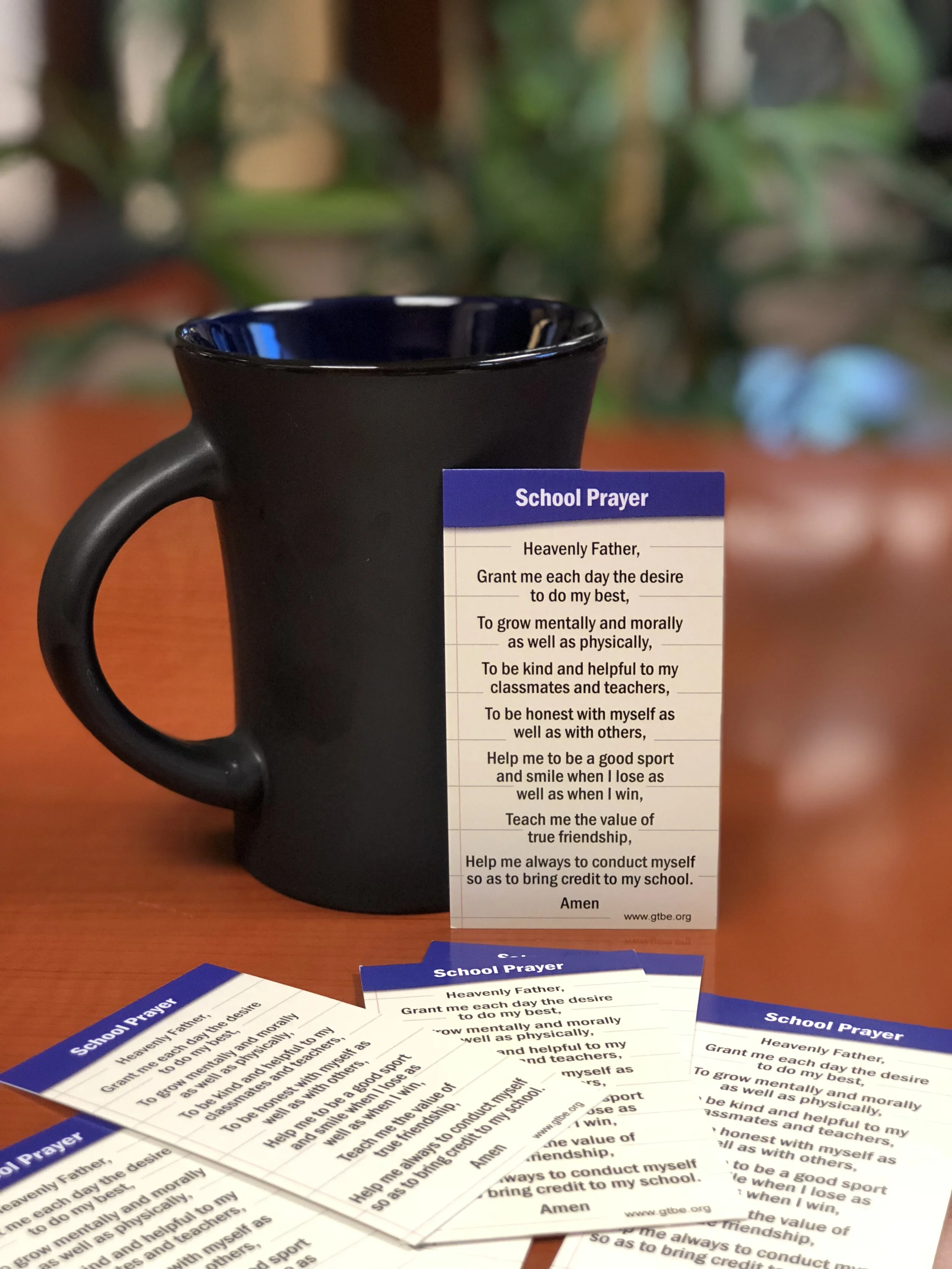
To help students actually begin the day in prayer, Gateways has created a prayer card that students can use in the classroom. The size of a business card, these easily fit in a wallet or binder. Wouldn't it be great if students prayed the following: 

Heavenly Father, 
Grant me each day the desire
to do my best, 
To grow mentally and morally
as well as physically, 
To be kind and helpful to my classmates and teachers, 
To be honest with myself as
well as with others, 
Help me to be a good sport
and smile when I lose as
well as when I win, 
Teach me the value of
true friendship, 
Help me always to conduct myself so as to bring credit to my school. 
Amen

Prayer Cards.jpg

Download a sheet of the cards and print out as many as you can use.

Or you can purchase a set of 100 prayer cards for $15

CLICK HERE to read about the news event that gave birth to this strategy.


FAQ
 

How do I know if my state allows for a moment of silence?

CLICK HERE for a list of the states that mandate or allow a moment of silence.

How do I know my school observes a moment of silence?

Contact your school secretary and ask if the students are given a moment of silence at the beginning of each day.

What to I do if my state allows or mandates for a moment of silence but my school district doesn’t observe it?

1. Check with your school superintendent’s office to see if there is a school board policy addressing a moment of silence that has been neglected.

2. If your school board has no such policy, meet with the superintendent to express your desire to see a policy implemented.  Bring two or three friends with you.  You can also meet with school board members individually to express your desire and gain their support.

What do I do if my school district has a policy but it is not being observed at my child's school?

Make a copy of the policy and contact your school principal. Use the “help me understand” approach to address the issue.

If the principal is disinterested or unwilling to implement the policy contact your superintendent. Explain to him that you are interested in seeing the current school district policy implemented in your child's school.

What do I do if my school already observes the moment of silence? 

Print out or purchase a set of Gateways School Prayer Cards. Give them to your own children to give to their friends. Ask your school’s Christian Club to distribute them to students. Provide them to parents of public school children in your church.